Free · open, never gated

Does your render need an AI label?

Article 50 of the EU AI Act applies to every studio selling into the EU, and most of the advice online is wrong in both directions. This is the plain reading, in two speeds: the large type tells the whole story in about five minutes, the small type holds the paragraph references and the edge cases.

Information, not legal advice. Nothing to sign up for, no email asked for. Every claim carries a reference to its source, and the sources are listed at the back of the book.

Does your render need an AI label?
Business of Archviz
Does your render need an AI label?

The EU's labelling rule for archviz renders and films, in two speeds.

Anees Alomar
Business of Archviz · Karlsruhe · 2026
Imprint and legal notice
Does Your Render Need an AI Label?
First edition · v1 · August 2026

© 2026 Anees Alomar. All rights reserved.
Business of Archviz · Anees Alomar
Mathystraße 11, 76133 Karlsruhe, Germany
[email protected] · businessofarchviz.com

This book is information, not legal advice. It does not create any advisory or attorney-client relationship. The author is an architect and business coach, not a lawyer. The European Commission's Guidelines cited in this book are non-binding, the Code of Practice is voluntary, and no court or authority has ruled on an architectural visualization case under this law. Authoritative interpretation of the AI Act can only be given by the Court of Justice of the European Union. To the extent permitted by law, the author and Business of Archviz accept no liability for actions taken or not taken on the basis of this book. Always verify against the official sources below and consult a qualified lawyer for your specific case.

The law itself: Regulation (EU) 2024/1689 (the AI Act), Article 50 · official text: eur-lex.europa.eu/eli/reg/2024/1689/oj · readable version: artificialintelligenceact.eu/article/50
All sources: page at the back of this book.

The example images in this book are AI-generated illustrations (Higgsfield), disclosed here and beside each image. They show no real project and no real place.
Concept and design: Business of Archviz · Set in Flecha S and Inter.
Business of Archviz3
Before you begin
This book reads at two speeds.

The large type tells the whole story. Five minutes, cover to cover. That is enough to know where you stand.

The small type holds the depth: the paragraph references, the edge cases, the exact wording. Read it when a page concerns your studio, or never. The story stands without it.

Every claim in this book cites its source: "¶" numbers point to the EU Commission Guidelines of 20 July 2026, "Code" to the EU Code of Practice of 10 June 2026. The full links are at the back. Check me.

Business of Archviz4
Since 2 August 2026, some renders need a label.
2 AUG 2026 before: nothing changes after: the rule applies
Article 50 of the EU AI Act. One rule, identical in all 27 EU states. It applies to what you publish from this date on. Nothing made and published before needs a label after the fact (¶154).
Business of Archviz5
Not all renders. Not even most.
Most studio work needs no label at all. The point of this book is to show you exactly which images do, so the rest of your work stays untouched, and documented as such.
Business of Archviz6
One law. Two duties.
THE TOOL'S DUTY YOUR DUTY
Duty one, Art. 50(2): the tool provider marks its outputs invisibly, in the file. Duty two, Art. 50(4): whoever deploys the AI adds a visible label, when the result is a deep fake. Keep them apart and most of the confusion disappears.
Business of Archviz7
The tool marks its output. That one is not yours.
THE TOOL MARKED IN THE FILE
Midjourney, Runway, Adobe, Topaz: they must mark what they generate, machine-readably. Metadata, invisible watermarks. You do not add this, and it does not show in the image. One exception that can bite: fine-tune a model and run it under your own name, and you become a provider yourself; the marking duty becomes yours too (¶15).
Business of Archviz8
You label the deep fakes. That one is yours.
AI VISIBLE. IN THE IMAGE.
The deployer, whoever decides to use the AI system and how, must visibly disclose AI-generated or AI-manipulated content, when it counts as a deep fake (Art. 50(4), ¶12). In archviz that deployer is usually the studio. So the whole question becomes one question: when does a render count as a deep fake?
Business of Archviz9
A deep fake is what a viewer would take as real, and isn't.
TAKEN AS TRUE
The legal definition, Art. 3(60): "AI-generated or manipulated image, audio or video content that resembles existing persons, objects, places, entities or events and would falsely appear to a person to be authentic or truthful." Intent does not matter; the test is objective (¶114). And the audience matters: what a public hearing takes as true is judged by the public, not by architects (¶115).
Business of Archviz10
A building counts. A place counts.
The Guidelines spell it out: "objects" includes buildings, "places" means realistic locations (¶113). A photorealistic AI image of a building on a site is exactly the kind of content the definition covers. This rule was not written about politicians only. It was written about your work too.
Business of Archviz11
"But it isn't built yet." Doesn't matter.
PLANNED PLAUSIBLE = COVERED
The definition says "existing", and every archviz brain jumps to the same escape: our project doesn't exist yet. The Guidelines close that door: it is enough that the subject "can plausibly exist" (¶113 ii). Only the physically impossible is out; the Commission's own example is a sphinx flying over the Eiffel Tower. Your work is plausible by profession.
Business of Archviz12
The question is never "did we use AI".

It is "what does the viewer take as true".
Business of Archviz13
Four cases cover your whole studio.
A: pure render, no AI. B: real model plus AI cosmetics. C: fully AI-generated. D: AI changed the building itself. Everything your studio ships is one of these four. One spread per case, with two examples each; the grey square marks what the AI touched.
Business of Archviz14
A B C D NO LABEL GENERALLY NO LABEL LABEL
The map. The line is never "AI or no AI": it is whether AI generated or changed the thing the viewer takes as the project.
Business of Archviz15
Part 2 · Case A · pure render
Pure render: no label.
Outside the rule entirely
Example visualization
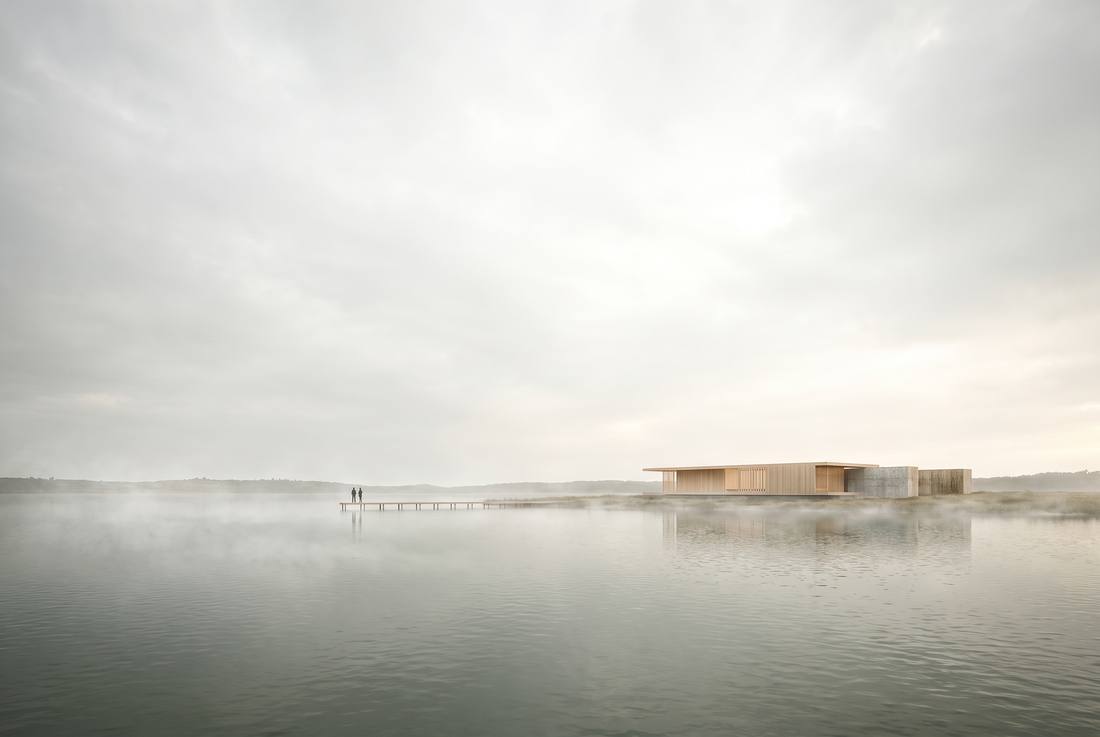
A pavilion across the lake · rendered from the model, no AI  example image: AI-generated
A frame rendered from your CAD or BIM model, no generative AI anywhere, is not an AI output at all: "a rendered frame … falls outside the scope" (¶64). However atmospheric the light, however painterly the mist: if it is computed from the model, it is outside the rule.
Business of Archviz16
Example visualization
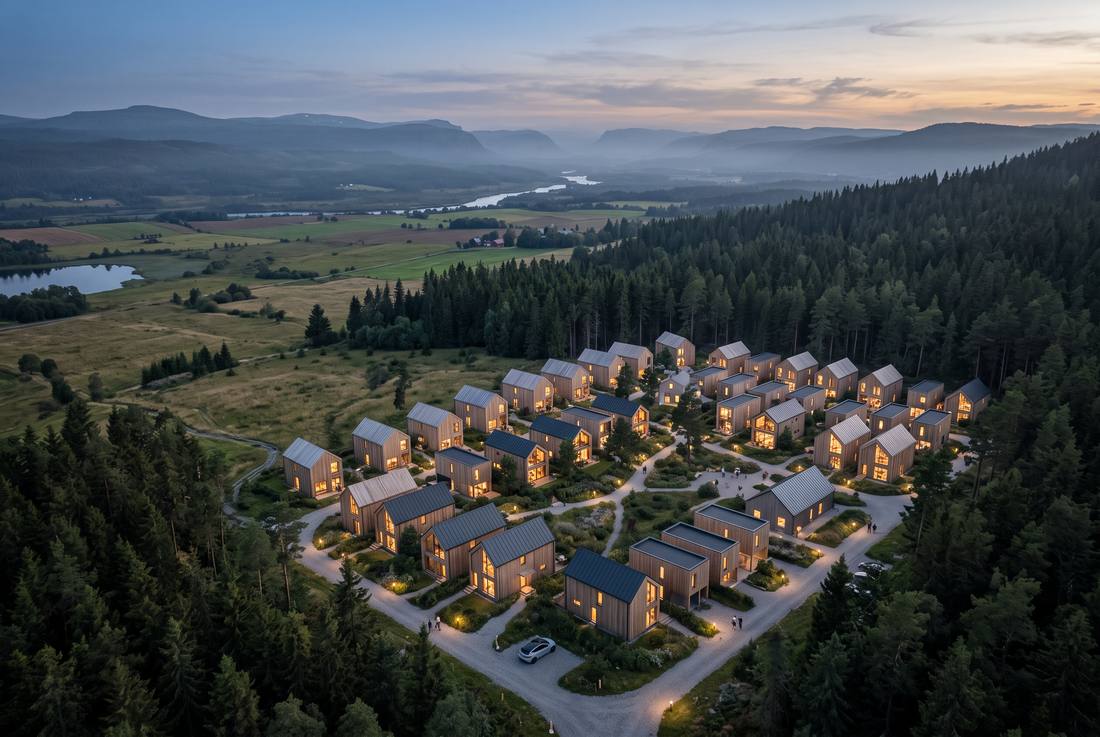
A housing quarter at dusk · rendered from the model, no AI  example image: AI-generated
Point clouds and meshes are out too (¶61). One boundary: AI-generated 3D and VR content is inside the rule and treated as video (¶61 to ¶62). Do this anyway: write "no generative AI" in the delivery record. The absence is worth documenting, because it is the strongest claim you own.
Business of Archviz17
Part 2 · Case B · real model, AI cosmetics
Real model, AI cosmetics: generally no label.
Generally no · assess each case
Example visualization
AI storm sky over the real building · building as modelled  example image: AI-generated
AI sky, vegetation, colour, mood, background atmosphere: minor edits. Background replacement "for clearly aesthetic purposes" has "only a minor impact" on authenticity (¶116); the Guidelines' own example list covers a real product "against an AI-generated background and surrounding environment".
Business of Archviz18
Example visualization
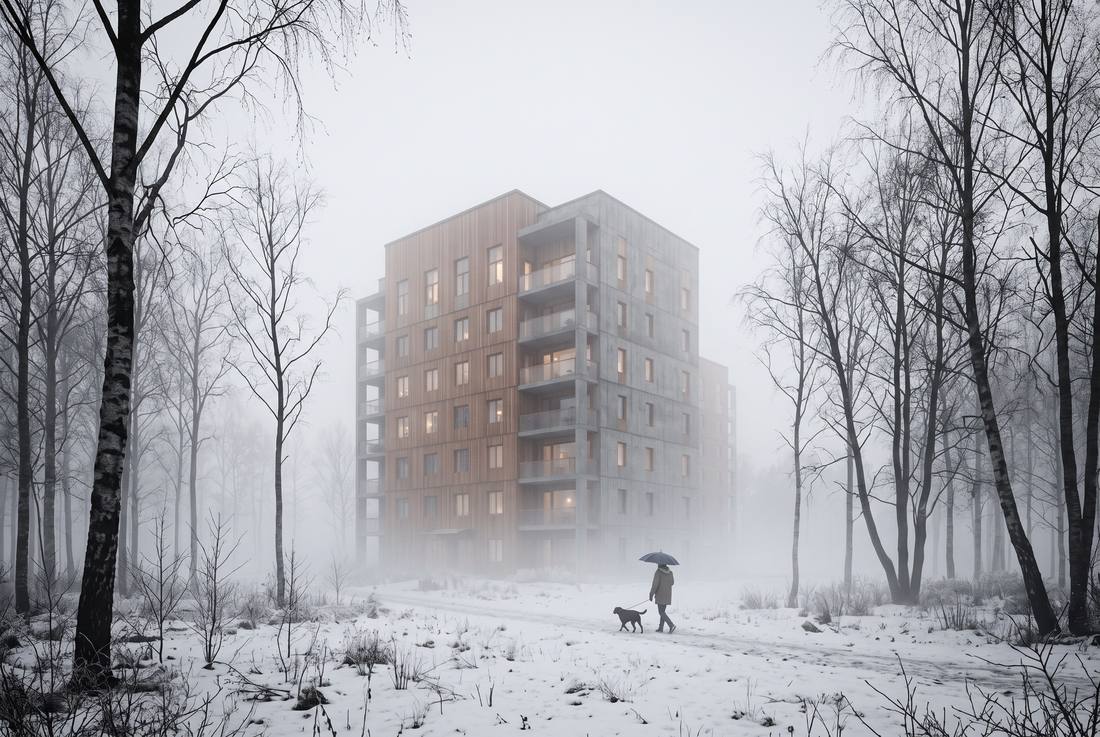
AI fog and winter mood · building as modelled  example image: AI-generated
Two conditions. The project comes from the real planning data, and the layers stay truly cosmetic. Background people who decorate are here; people who carry the message are the grey zone two spreads on. And a generative upscaler that invents façade detail is not cosmetic any more (¶91). Assess each image; write it down.
Business of Archviz19
Part 2 · Case C · fully AI-generated
Fully AI-generated: label it.
Likely yes · standard form
Example visualizationAI
Looks like a photograph. It is a prompt.  example image: AI-generated
Text-to-image, image-to-video, a whole photoreal scene with no planning model behind it. Buildings count (¶113), plausible counts as existing (¶113 ii), and photorealism makes deception likely (¶114). The more it looks like an award-winning photo, the more it needs the two letters.
Business of Archviz20
Example visualizationAI
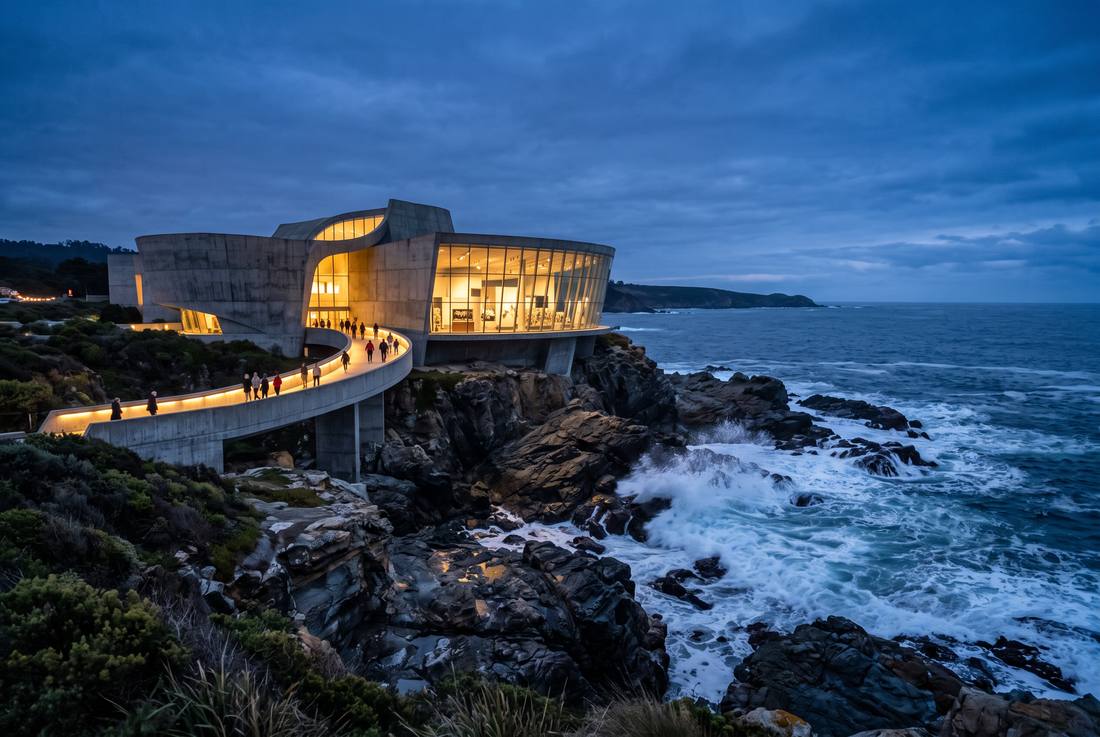
A building that exists nowhere, on a coast that exists nowhere  example image: AI-generated
And "it's creative work" will not save a marketing film: informative or commercial content gets the standard label, and when content is both, "the informative character should always prevail" (¶122). Label it, top corner, from the first second.
Business of Archviz21
Part 2 · Case D · AI changed the building
AI changed the building: label it.
Likely yes · or fix the model
Example visualizationAI
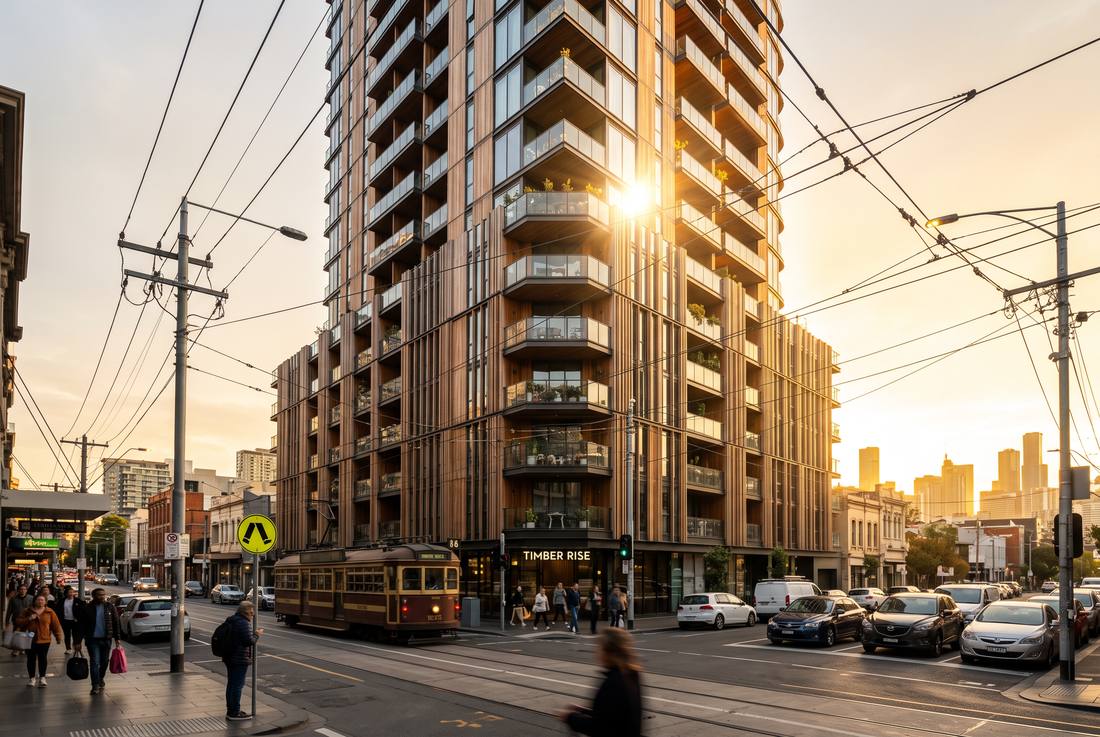
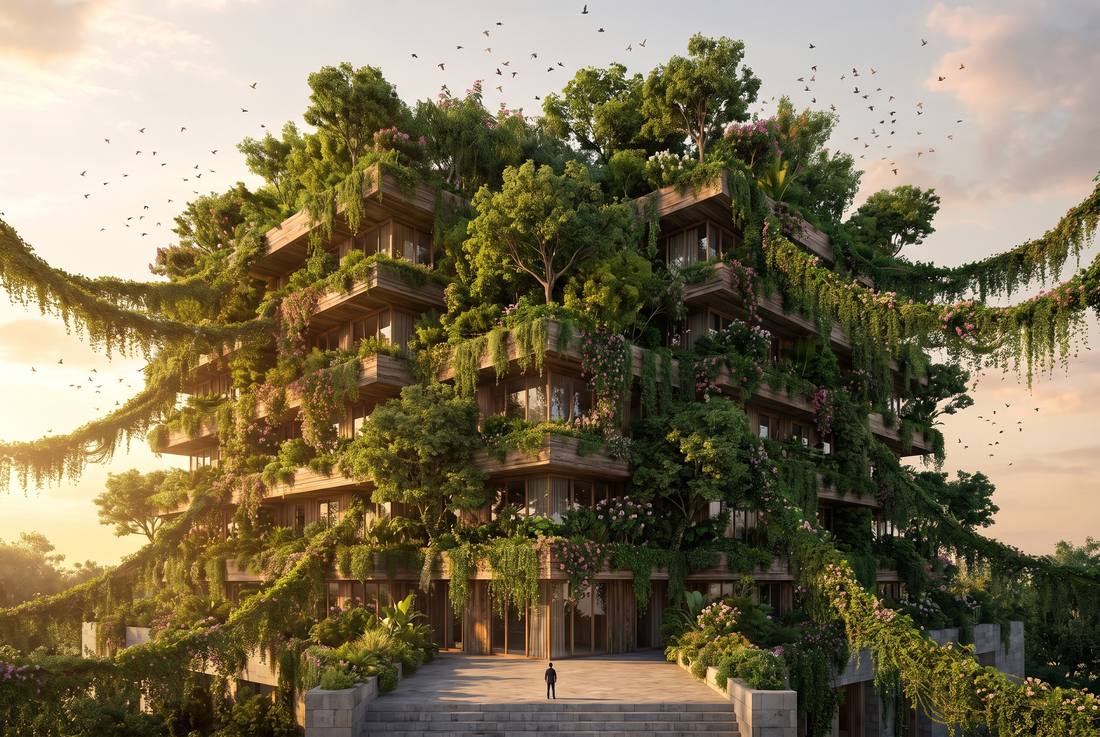
A vertical forest no structure could carry  example image: AI-generated
AI swaps the façade, invents an entrance, grows a forest the plans cannot hold. This is the Guidelines' own advertising example: making the product appear "more appealing … than in real life" (¶116). Your product is the building.
Business of Archviz22
Example visualizationAI
A crown and a cantilever the plans have never seen  example image: AI-generated
The image promises what the drawings do not contain, model or no model underneath. The honest alternative: if the design decision is real, change the model, then render. Case D becomes Case A or B, and the label question disappears with the invention.
Business of Archviz23
Part 2 · The grey zone
The grey zone: AI people who make the argument.
Case by case · when in doubt, label
Example visualizationAI
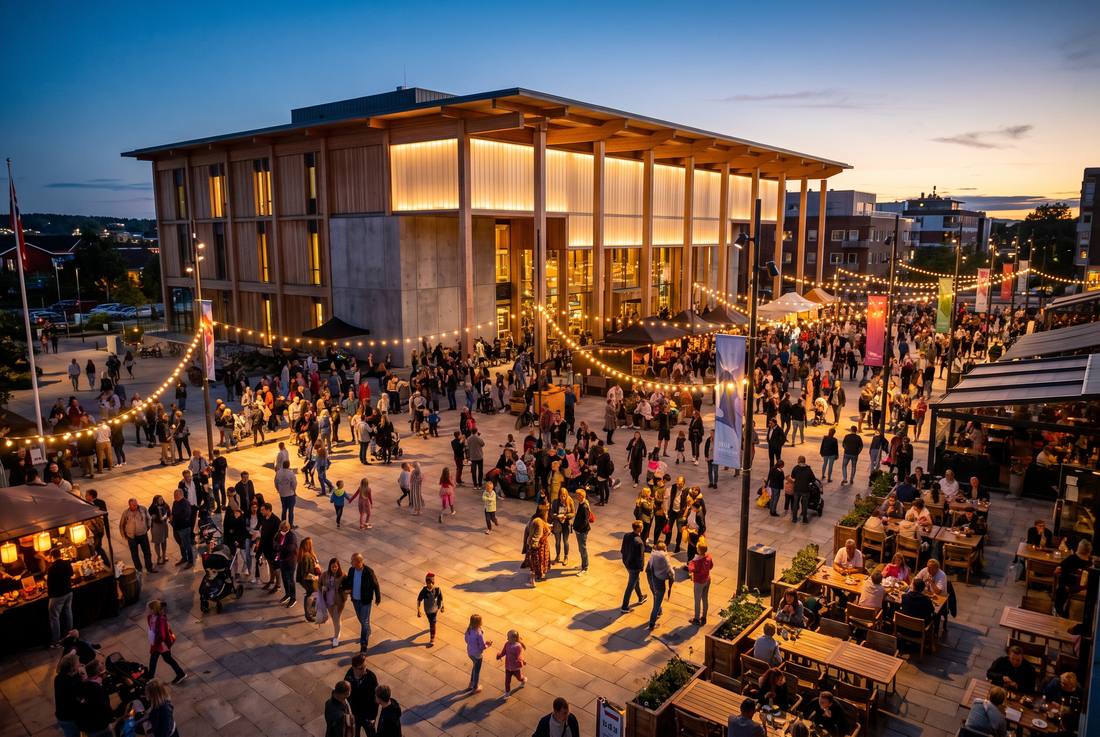
The festival is the promise. The crowd is AI.  example image: AI-generated
Background people are cosmetics. But when the people are the point, the square is alive, the café works, the promenade draws the whole town, the AI is generating the "essential elements that impact audience perception" (¶114).
Business of Archviz24
Example visualizationAI
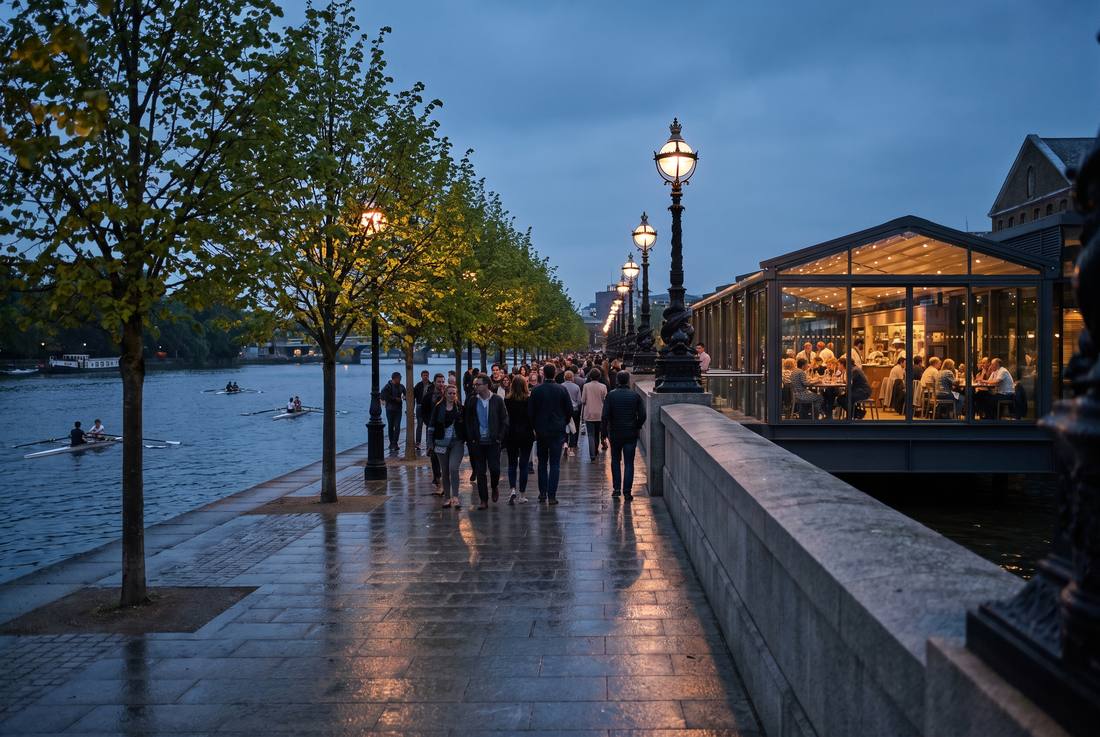
The promenade everyone already loves. Nobody has walked it.  example image: AI-generated
A council deciding on a public space partly decides on that crowd. No safe harbour; you assess each case. The test: if removing the AI people removes the argument, label. A corner icon costs nothing; a misleading hearing exhibit costs credibility.
Business of Archviz25
When in doubt, label. It costs two letters.
AI
There are no court decisions yet, so doubt will happen. Treat the label as the cheap option, because it is. A corner icon does not say "fake"; in 2026 it reads as professionalism. An unlabelled image someone later challenges costs more in one meeting than a hundred labels.
Business of Archviz20
Before anything leaves the studio: five questions.
1Did a generative AI tool generate or change anything in this image or film?
2Is the AI part cosmetic only, and the building and site exactly as in the planning model?
3Did AI generate or change the building, the site, or the people who tell the viewer how the place is used?
4Would the audience take it as a true picture of the project?
5Who publishes it, and does the label survive cropping, reposting, printing?
Two minutes per deliverable, at export. The next five pages take them one at a time.
Business of Archviz21
One: did AI touch it at all?
ANY GREY ANYWHERE?
No: done. Outside the rule (¶64). Write "no generative AI" in the record and deliver. Yes: next question. Check the actual pipeline, not your memory of it: the plugin someone used at midnight counts. Rendering engines computing light are not generative AI; Generative Fill, AI skies, image-to-video are.
Business of Archviz22
Two: cosmetic only, and the model true?
HOLD IT AGAINST THE PLANS
Yes to both: generally no label (¶116). Log the layers and deliver. No, or unsure: next question. "Cosmetic" means sky, vegetation, colour, mood, plain upscaling, decorative people. "Model true" means someone could hold the image against the plans and find no invented geometry or materials. An upscaler that invents new building detail already fails this question (¶91).
Business of Archviz23
Three: did AI change what the image argues?
THE ESSENTIAL ELEMENTS
The building, the site, the people who carry the message of use or scale: the "essential elements that impact audience perception" (¶114). No: the AI stayed decorative after all; log and deliver. Yes: you are in labelling territory. The next question decides the form.
Business of Archviz24
Four: would they take it as true?
YES: STANDARD LABEL NOBODY WOULD: NO LABEL
Photoreal, used where people decide (marketing, sales, a hearing, the press): they take it as true; standard visible label. An obvious sketch or stylised study that nobody takes as a truthful depiction fails the deep-fake test itself; no label at all (¶114). Between them sits the evidently artistic work that could still mislead: a real deep fake with a lighter disclosure, icon next to the frame or in the credits (¶120 to ¶123, Code Commitment 3). Be honest about "evidently": a photoreal image on a project website is not evidently anything except the project.
Business of Archviz25
Five: does the label survive publishing?
STUDIO · CLIENT · THE CROP
The label must be visible at the audience's first exposure (Art. 50(5)), not in your export folder. Export with the icon in place, in every format. Tell the client in writing what is labelled and why. Agree who keeps the label on when the film is cropped, reposted or printed (¶12). Deliver a labelled 9:16 and 1:1 yourself; do not leave the crop to an intern.
Business of Archviz26
Whoever decides to use the AI carries the duty.
TOOL STUDIO CLIENT PLATFORM
The law's word is deployer: whoever takes "responsibility over the decision to deploy the system and over the manner of the actual use" (¶12). Not the freelancer who pressed the button (¶14). Not the platform that displays the film (¶16). Whoever decides.
Business of Archviz27
In a normal commission, that's the studio.
BRIEFS DECIDES THE TOOLS
The Commission's own example: a company "that merely commissions an advertising agency … without taking decisions and exercising control over whether and how the advertising agency uses AI … is not a deployer" (¶14). Swap agency for studio and you have the normal case. That is not bad news: the assessment happens where the knowledge is. You know what is AI-touched. Your client usually does not.
Business of Archviz28
Unless the client takes the wheel.
THE CLIENT RUNS THE AI
The test is control over "whether and how" AI is used (¶14). A client that runs AI on your deliverables in-house, upscales, edits, cuts AI social versions, or takes over the production decisions, carries the disclosure duty for what it changed. Merely writing "please use Midjourney" in a brief does not settle it; control does. Most clients have no idea this line exists. Tell them before the project, not after a complaint.
Business of Archviz29
Put it in the contract. One clause is enough.
What the clause says, in plain words: the studio documents the AI layers per deliverable and confirms whether the building is shown as in the model. Where a label is needed, the studio applies it before delivery and says so in the delivery note. The client preserves the label in every use and tells the studio before any use that would remove or cover it. Where the client takes control of the AI use or manipulates the files itself, the corresponding duties move to the client. Deployers in longer chains are expected to secure the label downstream "via contractual conditions" (¶12). Sample legal wording on request; have a lawyer draft yours.
Business of Archviz30
The label is two letters.
AI
The capitalised acronym "AI", in English, is the main element (Code, Measure 1.1a). The EU publishes an official icon, free for anyone to use. Size, colour and style are yours, as long as it stays readable against the background. No legalese, no disclaimer burned into the frame. Following the Code's format is the cheapest defensible route: whoever labels differently must show, by other means, that their way meets the law (¶148).
Business of Archviz31
In the corner. From the first second.
START · INTERVALS · AFTER EVERY BREAK
Clear and distinguishable at the latest at first exposure (Art. 50(5)). Placed where nothing overlays it; top-right is the Code's own example, not a command (1.2.2a). For video: at the beginning, at regular intervals, at minimum after interruptions (1.2.2b). Screenshots and clips travel; the repetition makes the label travel with them. Simplest habit: keep the icon on for the whole AI-generated segment.
Business of Archviz32
Hidden doesn't count.
PAGE 14 OF THE TERMS
Information that "can be easily overlooked or missed" under normal viewing is not a label (¶142): a note in the terms of use, a mention buried in menus, a watermark you need to hunt for, a caption that disappears when the image is shared. And metadata alone is not a label either: deployers "cannot rely on the machine-readable marking" embedded by the tool (¶117). The test: would a normal viewer, watching normally, notice it?
Business of Archviz33
"It's art" won't save a marketing film.
EVIDENTLY A SKETCH SOLD AS THE PROJECT
A lighter disclosure exists for deep fakes inside evidently artistic works: icon next to the frame, in the credits, in the description (Code, Commitment 3). The Guidelines read "evidently" strictly: exclusively informative or commercial content is excluded, and mixed content follows its informative character (¶122). A project film informs buyers about a real project. Assume the standard form. The cleaner exit is different: an obvious sketch nobody takes as true is no deep fake at all, and needs nothing (¶114).
Business of Archviz34
Say what the AI did. That's not a confession. That's provenance.
AI "AI: SKY AND VEGETATION. BUILDING AS IN THE PLANNING MODEL."
The Code encourages a second layer: "generated" or "modified", and what was changed (Measure 1.1b). For most industries a burden. For you, the one claim competitors can't fake: the project is real where it matters, and honest about the rest. Verifiable against the plans. A label written like this doesn't weaken the image. It certifies it.
Business of Archviz35
One rule. Twenty-seven states.
ONE RULE · 27 STATES
The AI Act is a Regulation, not a Directive. It applies directly in every member state, which means there is no national version of Article 50 to look up: the text you have to satisfy is the one on the previous pages, and it is the same text in every one of the twenty-seven. What each member state does appoint is its own supervisory authority (Art. 70) — the office that would take a complaint. That is the one thing worth knowing locally. And the duty does not follow your address: content made for an EU audience is in scope wherever the studio sits (¶13).
Business of Archviz36
Old work stays old. And the "delay" you heard about is not yours.
NO RETROACTIVE LABELS FROM 2 AUG 2026
Published before 2 August 2026: no retroactive labelling; you are encouraged to add it where easy, not expected to audit archives or reprint brochures (¶154). The "AI Omnibus" transition to 2 December 2026 covers only the tool providers' machine-readable marking for systems already on the market (¶153). Your visible label, Duty two, applies since 2 August 2026. Anyone telling you "it's postponed" has mixed up the two duties.
Business of Archviz37
And never claim "AI-free".
"AI-FREE" FROM THE REAL PLANS
One AI sky in one delivery makes "AI-free" false, and the falseness is checkable: the tool's invisible marks sit in your files, and platforms are learning to read them. Say the claim that survives an audit instead: built from the real planning data, verifiable against the plans, AI used only where stated. Provenance, not abstinence.
Business of Archviz38
Four habits make this a non-issue.
1Log the layers. One row per deliverable: tool, what it touched, model true or not, label decision, who applies it.
2State the provenance. One line on every delivery note: model version, what AI did, verifiable against the plans.
3Keep the marks. Don't strip metadata at export; switch on Content Credentials where your tools support them.
4Label in the preset. One overlay preset per format: still, 16:9, 9:16. A checkbox at export, not a decision at 11 pm.
A spreadsheet, a sentence, a setting, a preset. No lawyer required. The five questions fill the log; the log answers every client question before it is asked.
Business of Archviz39
The provenance line does the selling.
The template: "This visualisation was produced from the planning model [name, version, date] supplied by [client]. The building, site and dimensions are shown as in the model and can be verified against the plans. Generative AI was used for: [sky, vegetation / none]. Prepared by [studio], [date]." Copy it. Fill the blanks. It answers the law, and it positions you in the same breath.
Business of Archviz40
Document what the AI did.

Label what a viewer would believe.
That is the whole rule, and the whole workflow. Everything else in this book is detail.
Business of Archviz41
For your clients · copy this page
Three questions for your visualisation partner.

1. Which elements of our images and films are AI-generated or AI-manipulated? You want a list per deliverable.

2. Is the building and the site shown as in the planning model, or generated? Model-true renders with cosmetic AI generally need no label. AI that invents or changes the building generally does.

3. Who labels, and how does the label survive publishing, cropping, printing? Agree it in writing.

A good answer looks like: a one-line provenance statement on every delivery, a label on anything the studio judged as needing one, and a clause in the contract about who preserves it. Since 2 August 2026 this is EU law (Regulation (EU) 2024/1689, Article 50); the duty usually sits with the studio, but the film carries your project's name.

Business of Archviz42
Sources · check every claim
The law: Regulation (EU) 2024/1689, Art. 50, Art. 3(60), Art. 99 · eur-lex.europa.eu/eli/reg/2024/1689/oj · readable: artificialintelligenceact.eu/article/50
The ¶ numbers: European Commission, Guidelines on the transparency obligations under Article 50, C(2026) 5054, 20 July 2026 · digital-strategy.ec.europa.eu
The label format: Code of Practice on the transparency of AI-generated content, 10 June 2026 · PDF via ec.europa.eu
The official icon, free to use: digital-strategy.ec.europa.eu · EU icons
Penalties for the record, stated once: up to €15 million or 3% of worldwide annual turnover, whichever is higher; for SMEs, whichever is lower (Art. 99(4)(g), Art. 99(6)). These are maximums, not tariffs. No archviz case exists anywhere.
Business of Archviz43
Once more, in plain words
This book is information, not legal advice.

The Commission's Guidelines are non-binding. The Code of Practice is voluntary. No court or authority has ruled on an archviz case under this law, and nothing in this book predicts how your content would be assessed.

For a specific question: your national supervisory authority, or a lawyer. For everything else: the sources on the previous page, one click deep.

Business of Archviz44
About

Anees Alomar, founder of Business of Archviz. Architect, licensed in Germany and Syria. Coaches architectural visualization studios on positioning, pricing, sales and systems.

This book was researched from the primary legal texts in full: the AI Act, the Commission's Guidelines and the Code of Practice, with every claim cross-checked against the sources cited at the back.

Business of Archviz · Karlsruhe
[email protected] · businessofarchviz.com
Business of Archviz45
One more thing
Labelling is the easy half.

Knowing what to disclose does not tell you what to sell, who to sell it to, or why the last three enquiries went quiet. That is a different conversation, and it starts with your own numbers rather than the law.

Thirty minutes on your actual figures. €107, credited if you continue. You leave with a thirty day action plan and a written ninety day roadmap.

Book the Studio Health Check
businessofarchviz.com/health-check-call
Business of Archviz46
Document what the AI did.
Label what a viewer would believe.
businessofarchviz.com · © 2026 Business of Archviz

Fifty-three pages · arrow keys, or click the edges

Download the PDF Read the law itself