One system, built for how archviz clients actually hire
ABOS, the Archviz Business Operating System. Not generic marketing and not a tactic borrowed from another industry. A business-to-business system built for how your clients actually hire an archviz studio, and for how you get perceived as a partner rather than a supplier.
The people selling tactics on YouTube built them to sell a course to thousands, or a cheap service to anyone. You sell to a developer who signs once a year. That relationship takes weeks, sometimes years, and it runs on trust before money. Spray-and-pray marketing does not build trust. It spends it.
It starts with a reason, and ends with a partner
First, sell items and you can be replaced. Sell outcomes and you can’t
They ask for images. Ask why, four times, and you reach the reason they pay: they need early funds, and for that the buyer has to trust what you show them. That is the outcome. Sell there, and an image is no longer what you sell, so a cheaper image is no longer your competitor.
Then you never reach out without a reason
A signal is something happening in the client’s market: a site bought, a permit granted, a launch announced. Reach out with a signal and people reply. Reach out without one and you are spam, however polite the writing is.
There are three ways in, and none of them looks like email
Each way has its own cost, its own risk and its own lifetime, and each one decides how big the first product should be. You do not pick one. The system runs all three, and the first goal of every one of them is a meeting, never the job.
Direct mail
Costs time. A printed letter or portfolio book keeps converting for one to two years.
Paid ads
Costs money. Validates whether the message works, faster than anything else.
In person
Costs effort. Buys the highest trust per hour of anything available to you.
The three you have already tried cost more than they bring
Posting on social
Costs your evenings. Architects do not scroll looking for you.
Cold email
Costs hope. Under one per cent answer. Measured across my clients, then dropped.
Waiting for referrals
Costs the year. Referrals are rain. Real water, and not a plan.
None of the three is a way in. They are what studios do instead of having one.
In the meeting, you never quote what they asked for
They ask for three images. You do not quote three images. You offer a visual solution for that project, at the price you decided before the call, with other things inside it, and now there is nothing to compare you with. You decide the price with the client you chose, the outcome you sell and the signal you came in on already in hand.
Almost nobody in this market sells this way. The usual approach is a script: ask this, then say that, then close. This is the opposite. You look at what the client is trying to achieve, you tell them what you would do about it, and you put it in writing. Sometimes that means telling them the thing they asked for is not the thing they need. That sentence is what wins the work.
All of it runs on numbers, and here they are
10 to 20%
reply to a fast letter campaign, to clients you chose, with a signal in the first line.
2 to 5
new clients per campaign. One campaign a month, each still working six to twelve months later.
€20 to 30
per lead. Print, postage, the list and the work to make it, all counted.
And you watch the whole thing on one screen
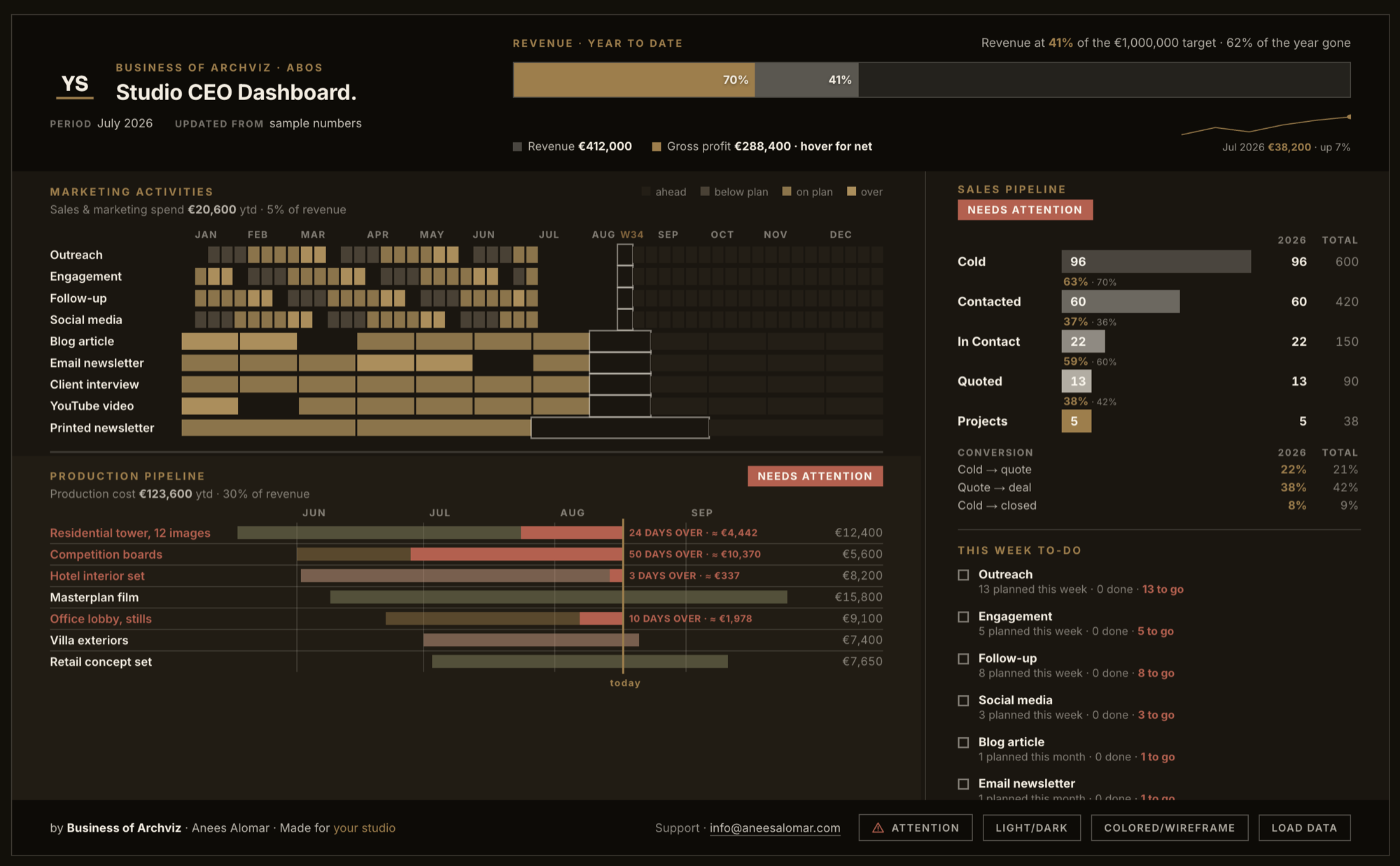
Five windows: revenue against the target, the marketing activities, the sales pipeline, the projects pipeline, and what has to happen this week. All of it comes from one business development plan, and everyone on the team enters their part.
The first year: three months of setup, then nine campaigns
The first three months build the system. The first campaign goes out in month four, and from then on one campaign goes out every month while the rest is still being built. Every campaign gets two follow-ups, and each one keeps bringing leads for at least six months. You do not wait for the build to finish before the phone rings.
None of it gets built from a web page
Every piece above is drawn on your studio’s own data before it is built: your market, your clients, your numbers, your signals. That is what the thirty minutes is for. You leave it with all of this marked up for your studio and a written ninety day roadmap, whether or not we work together afterwards.
Same system every time. What changes is whose hands build the machine, and what that costs. Three ways in, and all three start with the same thirty minutes.
See the three ways to build it The Health Check, then Essential at €2,000, Guided at €6,000 and Installed at €30,000. What each one includes, and what I do when the easy thing would be to take your money.